
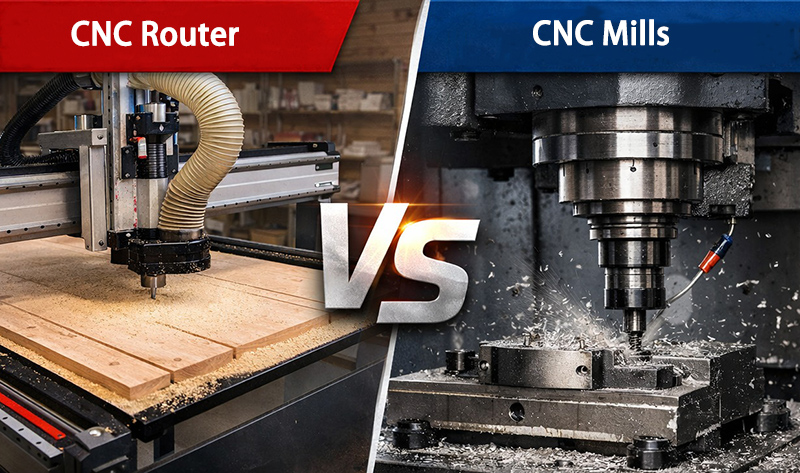
Selecting the right CNC machine directly affects machining accuracy, production efficiency, and manufacturing costs. Among the most common options, CNC routers and CNC mills are often compared because both use computer numerical control (CNC) technology but are designed for different machining tasks.
A CNC router is built for high-speed cutting of softer materials and large workpieces, while a CNC mill focuses on precision machining, deeper cuts, and hard metal processing. Understanding their differences helps manufacturers, workshops, and engineers choose equipment that matches their production requirements.
This guide compares CNC routers and CNC mills, including their design, working principles, applications, advantages, and major differences, to help you make an informed decision.
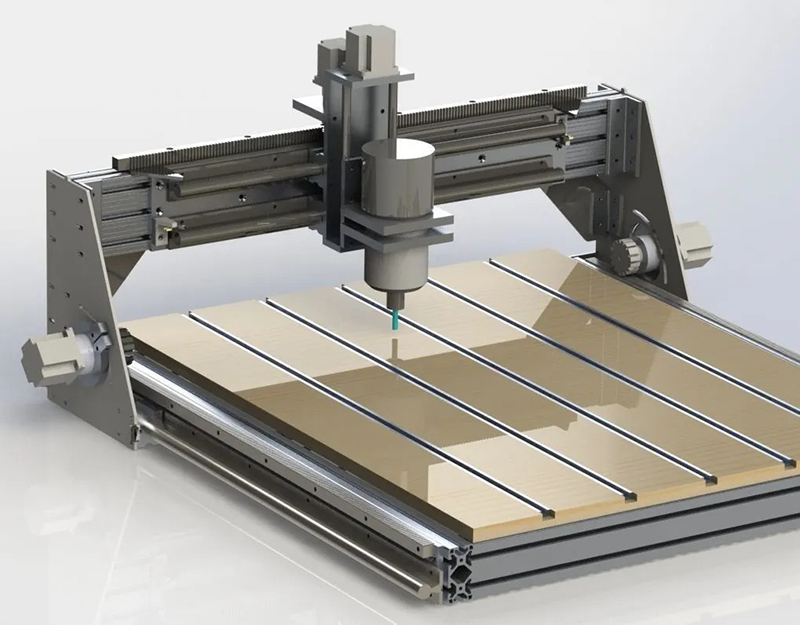
A CNC router is a computer-controlled cutting machine designed for fast and efficient machining of relatively soft materials. It moves a rotating cutting tool along programmed toolpaths to cut, engrave, carve, drill, and shape different materials with high speed and repeatability.
Unlike manual routing, a CNC router performs every movement automatically through CNC programming, reducing operator error while improving productivity and consistency. Because of its large working area and fast spindle speed, it is widely used for sign making, furniture production, woodworking, plastic fabrication, and composite material machining.
Modern CNC routers are available in different sizes and axis configurations, allowing manufacturers to produce everything from simple panels to complex three-dimensional components.
Different CNC routers are designed to meet different production requirements. The most common types include:
A 3-axis CNC router moves along the X, Y, and Z axes. It is the most common configuration and is suitable for flat surface machining, engraving, cutting, drilling, and profile machining.
A 4-axis router adds a rotary axis, allowing cylindrical parts and curved surfaces to be machined with greater flexibility. It is commonly used for furniture legs, sculptures, and decorative columns.
A 5-axis CNC router enables simultaneous movement in multiple directions, making it ideal for producing complex three-dimensional components with fewer setups. Industries such as aerospace, marine, automotive, and mold manufacturing often use this configuration.
Automatic Tool Changer (ATC) routers automatically switch between different cutting tools during machining. This improves productivity, reduces manual intervention, and increases machining efficiency for complex projects.
A CNC router consists of several important components that work together to deliver accurate and repeatable machining.
The machine frame provides structural support and maintains overall rigidity during cutting operations.
The gantry carries the spindle assembly and moves across the worktable, allowing the cutting tool to reach different machining positions.
The spindle rotates the cutting tool at high speeds, typically between 18,000 and 24,000 RPM, making it suitable for rapid machining of softer materials.
The worktable securely holds the workpiece during machining. Vacuum tables and T-slot tables are the most common workholding systems.
These components ensure smooth, accurate movement across each machine axis while minimizing vibration and positioning errors.
The controller interprets G-code instructions and automatically coordinates spindle movement, feed rate, and machining operations.
|
Aspect |
Advantages |
Disadvantages |
|
Speed |
High spindle speed enables fast machining and shorter production cycles. |
High-speed operation is less suitable for heavy metal cutting. |
|
Work Area |
Large tables accommodate oversized sheets and large components. |
Requires more floor space than compact machining equipment. |
|
Material Compatibility |
Excellent for wood, plastic, foam, acrylic, composites, and aluminum. |
Limited capability when machining hardened metals. |
|
Productivity |
Supports automatic tool changing and continuous production. |
Tool wear increases during heavy-duty cutting. |
|
Cost |
Lower purchase and operating costs than CNC mills. |
May require additional finishing operations for precision metal parts. |
A CNC mill is a computer-controlled machine designed to remove material from a workpiece with exceptional accuracy. Unlike a CNC router, which is optimized for speed and softer materials, a CNC mill is built with a rigid structure and a high-torque spindle to machine hard metals and produce components with tight tolerances.
The machine uses rotating cutting tools to perform various machining operations, including face milling, slot milling, pocket milling, contouring, drilling, boring, and tapping. Every movement is controlled through CNC programming, ensuring consistent results across single-part production and high-volume manufacturing.
CNC mills are available in different configurations to meet various machining requirements. The most common types include:
A vertical CNC mill has a vertically mounted spindle that moves above the workpiece. It is commonly used for precision milling, drilling, slot cutting, and general machining operations. This type is popular because of its versatility and relatively simple operation.
A horizontal CNC mill positions the spindle horizontally, allowing better chip evacuation and improved cutting performance during heavy-duty machining. It is ideal for large components and high-production environments.
A 3-axis CNC mill moves the cutting tool along the X, Y, and Z axes. It is suitable for machining flat surfaces, slots, holes, and simple three-dimensional parts.
A 4-axis machine adds a rotary axis, allowing workpieces to rotate during machining. This improves efficiency by reducing manual repositioning and enabling machining on multiple sides.
A 5-axis CNC mill enables simultaneous movement in five directions, allowing the manufacture of highly complex parts with exceptional accuracy. It is commonly used for aerospace components, medical implants, precision molds, and automotive parts.
A CNC mill is built with heavy-duty components that provide stability during demanding machining operations.
The base supports the entire machine and absorbs vibration during cutting, helping maintain machining accuracy.
The column provides structural support for the spindle assembly while ensuring rigidity during machining.
The spindle rotates the cutting tool at controlled speeds with high torque. Although spindle speeds are generally lower than those of CNC routers, the increased torque allows efficient cutting of hard materials.
The worktable securely holds the workpiece using vises, clamps, fixtures, or rotary tables, ensuring stable machining throughout the operation.
Precision linear guides and ball screws control movement along each axis, providing smooth positioning and excellent repeatability.
Many modern CNC mills include an automatic tool changer that switches cutting tools without stopping production, reducing machining time and improving efficiency.
The controller reads G-code programs and coordinates spindle speed, feed rate, tool changes, coolant flow, and machine movements with high precision.
|
Aspect |
Advantages |
Disadvantages |
|
Precision |
Delivers outstanding dimensional accuracy and tight machining tolerances. |
Requires experienced operators or CNC programming knowledge. |
|
Material Capability |
Machines steel, titanium, stainless steel, cast iron, and other hard materials. |
Less efficient than routers when processing large sheets of soft materials. |
|
Rigidity |
Heavy-duty construction minimizes vibration and improves surface finish. |
A larger machine weight increases installation requirements. |
|
Versatility |
Performs milling, drilling, boring, tapping, contouring, and pocket machining. |
The initial purchase cost is significantly higher than that of a CNC router. |
|
Automation |
Supports automatic tool changers, pallet systems, and advanced multi-axis machining. |
Higher maintenance and operating costs due to complex mechanical systems. |
Although CNC routers and CNC mills both use computer numerical control (CNC) technology to automate machining operations, they are designed for different manufacturing purposes. Their machine structure, spindle performance, cutting capability, precision, and compatible materials vary significantly. Understanding these differences helps manufacturers select equipment that improves productivity while meeting machining requirements.
|
Aspect |
CNC Router |
CNC Mill |
|
Machine Structure |
Lightweight gantry-style design for high-speed machining |
Heavy-duty rigid frame designed for maximum stability |
|
Compatible Materials |
Wood, MDF, plywood, acrylic, plastic, foam, composites, aluminum |
Steel, stainless steel, titanium, cast iron, brass, copper, aluminum |
|
Spindle Speed |
High speed (typically 18,000–24,000 RPM or higher) |
Lower speed with significantly higher cutting torque |
|
Cutting Force |
Designed for light to medium cutting loads |
Suitable for aggressive heavy-duty machining |
|
Z-Axis Travel |
Limited cutting depth |
Greater Z-axis travel for deep machining operations |
|
Tool Capacity |
Supports routing, engraving, drilling, and cutting tools |
Supports end mills, face mills, boring tools, taps, reamers, and more |
|
Automation |
Available with ATC and multi-axis options |
Advanced automation, including ATC, probing, pallet changers, and 5-axis machining |
A CNC router uses a gantry-style design where the spindle moves across a stationary worktable. Since routers mainly process lightweight materials, manufacturers prioritize higher travel speed and larger machining areas instead of maximum rigidity.
In contrast, a CNC mill is built with a rigid cast iron or steel frame that minimizes vibration during machining. The heavier construction allows the machine to withstand higher cutting forces while maintaining excellent dimensional accuracy.
Because of this structural strength, CNC mills can machine hard metals without excessive tool deflection or loss of precision. CNC routers, although less rigid, offer greater flexibility when machining large workpieces at high speed.
Material capability is one of the biggest factors when choosing between these two machines.
A CNC router performs exceptionally well when machining soft materials, including:
Its high spindle speed allows clean cutting with minimal heat generation, making it ideal for woodworking, signage, furniture production, and decorative applications.
A CNC mill, however, is specifically designed for machining hard materials, such as:
Its high cutting torque enables deeper cuts while maintaining excellent machining stability.
If your production mainly involves metal components with demanding tolerances, a CNC mill is the better solution.
A CNC router provides excellent repeatability for woodworking, plastic fabrication, engraving, and panel cutting. It produces clean edges and consistent dimensions for most commercial applications. However, because routers operate at higher speeds with lighter frames, slight vibration may occur during heavy cutting operations.
CNC mills are engineered specifically for precision manufacturing. Their rigid construction, precision ball screws, and advanced control systems minimize vibration while improving positional accuracy. As a result, CNC mills are capable of producing components with extremely tight tolerances and superior surface finishes, making them suitable for industries where precision is critical.
A CNC router uses a high-speed spindle that commonly operates between 18,000 and 24,000 RPM, with some models exceeding this range. High spindle speed allows rapid material removal in soft materials while reducing production time. However, higher RPM comes with lower cutting torque, making routers less effective when machining thick or hardened metals.
CNC mills operate at lower spindle speeds but generate significantly greater torque. The increased cutting force enables deeper cuts and stable machining of difficult materials such as stainless steel and titanium. This balance between speed and torque explains why routers prioritize production speed, while mills prioritize machining power and accuracy.
The range of machining operations also separates these two machines.
A CNC router commonly performs:
These operations focus on speed and productivity rather than heavy material removal.
A CNC mill supports a much wider range of precision machining operations, including:
This versatility allows manufacturers to complete multiple operations on a single machine while maintaining tight tolerances.
|
Aspect |
CNC Router |
CNC Mill |
|
Purchase Cost |
Lower initial investment with a simpler machine structure. |
Higher initial investment due to rigid construction and advanced technology. |
|
Operating Cost |
Lower tooling, energy, and maintenance costs. |
Higher operating costs because of specialized tooling and machining systems. |
|
Routine Maintenance |
Clean dust, lubricate guides, inspect belts and bearings, replace cutting tools. |
Inspect ball screws, calibrate spindle, maintain coolant system, service tool changer, check machine alignment. |
|
Maintenance Complexity |
Simple maintenance that can often be performed by operators. |
Requires skilled technicians and scheduled preventive maintenance. |
|
Long-Term Value |
Cost-effective for woodworking and light-duty production. |
Excellent ROI for precision machining and high-volume metal manufacturing. |
Both CNC routers and CNC mills are widely used across modern manufacturing industries. However, their applications differ because of their machining capabilities and compatible materials.
CNC routers are ideal for industries that require fast machining of soft materials and large workpieces. Their high spindle speed and spacious worktable make them suitable for high-volume production.
Common applications include:
CNC mills are designed for industries that demand high precision and heavy-duty machining.
Typical applications include:
1. Can a CNC router replace a CNC mill?
No. A CNC router is designed for high-speed machining of softer materials, while a CNC mill is built for precision machining of hard metals and complex industrial components.
2. Which machine is better for woodworking?
A CNC router is the preferred choice because it offers higher spindle speeds, a larger work area, and excellent efficiency when processing wood-based materials.
3. Can both machines perform drilling operations?
Yes. Both CNC routers and CNC mills can drill holes, but CNC mills provide greater drilling accuracy and are better suited for machining hard metals.
4. Which machine requires more maintenance?
A CNC mill generally requires more maintenance because it contains more complex mechanical systems and operates under higher cutting loads.
5. Which machine is better for mass production?
It depends on the application. CNC routers are ideal for high-volume production of wood, plastic, and composite parts, while CNC mills are better suited for precision metal manufacturing.
6. How do I choose the right CNC machine?
Your decision should be based on material type, machining precision, production volume, budget, and future business requirements. Choosing the machine that best matches your manufacturing goals will provide the highest long-term value.
Both CNC routers and CNC mills are important in modern manufacturing, but they are built for different machining tasks. CNC routers excel in high-speed cutting, large work areas, and efficient processing of wood, plastics, and composite materials. CNC mills, on the other hand, offer superior rigidity, higher cutting torque, and exceptional precision for machining hard metals and complex components.
If you're looking for reliable CNC machining solutions, CNC Yangsen offers a wide range of advanced CNC milling machines designed for precision, durability, and high-performance manufacturing. Contact our team today to find the ideal machine for your application and take your production capabilities to the next level.