
Manufacturers and workshop owners face a critical decision:
Should you continue relying on manual machining or invest in CNC technology?
Manual machining has served traditional manufacturing for decades—but with complex parts, higher precision requirements, and competitive delivery schedules, many shops are upgrading to CNC.
In this article, we’ll compare the real differences between manual and CNC machining, explain how they impact cost, precision, and productivity, and help you decide which solution works best for your specific application.
It is possible to state that CNC and manual machining came from two completely different concepts; therefore, let us explore the two terms in detail before diving into the differences. Let's break it down:
It's comparable to having a personal robot who becomes a craftsman who works for you. They are assembly lines in production that are controlled by computer-driven software, which automates the movements of the tools and machines in the factory. It is like having a master remote control- perfect for operating different mechanical tools such as mills, routers, and lathes,
Here's how it works: A solid part is modeled in 3D CAD, then again to define the set of commands for the CNC machine. These instructions are frequently in a language called G-code, which outlines to the machine how it needs to move, where to cut, and how far to penetrate. The result? Millionths of a-mile components can be created with detailed fidelity, identical each time it is done.
Now, let's assume that an experienced weaver is working on a project to weave cloth. In a nutshell, this is how manual machining is conducted. It is mainly the old process of shaping, constructing, or altering mechanical components with manually operated tools. Thus, the machinist controls the workpiece and uses their skills, experience, and observational skills to manage the cutting tools.
In manual machining, the operator fully controls the particular apparatus's processes. They use drawings, prepare the machine, develop and choose tools, and maintain the tool's movement to achieve the required profile. This efficient technique depends quite heavily on the machinist's intelligent use of hands.
Now that we've got a grasp on what CNC and manual machining are let's dive into the key areas where these two processes diverge: Now that we've got a grasp on what CNC and manual machining are let's dive into the key areas where these two processes diverge:
And it comes with no surprise that when it comes to accuracy, computers have it in the bag with CNC machining. These machines can work to tolerances of ±0. 0001 inches or approximately 2. 5 micrometers. Wow, that is narrower than the thickness of a human hair. Such accuracy is achieved and maintained by hundreds or even thousands of components of a particular product.
As much as manual machining can be exact, especially from an operator's perspective, the overall accuracy of the job is not comparable to that of CNC machines. With the help of a great manual machinist, one might obtain variances of up to ± 0. The matching tolerance is ± 0.001 inches, which is good but still not at the level of CNC accuracy.
Manual methods can only partially comprise the provision of speed as those provided by CNC machines when it comes to production. One of the advantages of using a CNC machine is that once it is programmed, it can work all day and night, in this case, creating intricate parts if required. They do not require any sparing time, do not become weary, and do not decrease their performance rates.
On the other hand, manual machining is restricted by some factors involving people. Machinist that has mastered their trade still requires a break from work sometimes, and the production line can cause them to get weary. CNC proves to be more efficient when many parts are to be produced than other conventional methods.
It must be noted that CNC machining excels in developing micrographic designs with complicated geometric shapes. These machines can create components that include features that are almost impossible to make by hand. Consider structures with internal pockets, intricate contours, or elements that need five-axis motion – that's not a problem with Computer Numerical Control.
On the other hand, manual machining has a relatively more superficial approach but is flexible in customization and slightly restricted concerning the level of intricacy. Professionals can prove that they can build beautiful parts. Still, only so much can be done manually to standardize the curved surfaces, mainly when using templates.
This is where the tide starts to switch slightly in their favor. Compared to manual machining, CNC machining entails different kinds of skills. CNC operators should be conversant with the CAD/CAM software and be familiar with g-code instructions and procedures for setting up and troubleshooting the CNC machines. On the other hand, the result of developing a program is that when a program is designed and debugged, even lowly trained personnel can manage the machines.
Meanwhile, automatic machining habits require several years to learn, mainly involving hand machining techniques. Therefore, it is close to art, which requires knowledge and skills on the materials that the work involves, the cutting tools and the machining principles profile of a skilled manual machinist is a work of art in the real sense.
| Feature | Manual Machining | CNC Machining |
| Accuracy | Medium (±0.1–0.3 mm) | High (±0.01–0.03 mm) |
| Repeatability | Low | Very High |
| Production Speed | Low | High |
| Labor Intensity | High | Low |
| Cost per Part (Batch) | Higher | Lower |
| Complexity | Low to Medium | High |
| Toolpath Control | Manual | CAM/CNC |
| Programming | Not required | Required |
| Best For | Simple parts | Complex & 3D parts |
Now that we've covered the key differences let's explore some of the standout advantages of CNC machining: Now that we've covered the key differences let's explore some of the standout advantages of CNC machining:
One of the most appreciated advantages of CNC machining is that it allows for creating parts that are as alike as possible. Once it is set and tuned, one can make one piece or one thousand pieces, and they all come out almost the same. This uniformity is essential in aerospace and automotive parts production and medical instrument fabrication applications, as minor deviations can be fatal.
As human intervention is eliminated to a large extent while cutting operations, the possibility of errors is drastically diminished with CNC machining. For example, in painting, there is no way one can imagine that due to a short distraction of the mind, the part being painted gets spoiled. That is why a company's management is focused on increasing quality, as this leads to less waste and cost.
But there is no denying that CNC machining is one of the best options for mass production. These machines can work 24/7 and generate parts at a pace that cannot be attained by hand. This makes CNC ideal for mass production, where the focus is usually on the number of parts to be produced and the rate at which they will be created.
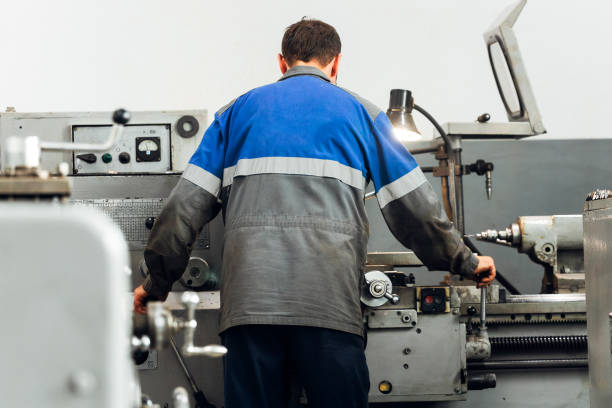
While CNC machining has many advantages, manual machining still holds its own in specific areas: While CNC machining has many advantages, manual machining still holds its own in particular areas:
Some of the benefits that can be associated with manual machining include the following: one of the main benefits is that it has a low threshold cost. Compared to fully computerized CNC machines, manual machines are relatively cheaper and suitable for small shop owners or casual users. A good quality manual lathe or mill might cost a few hundred dollars or even less than the price of the CNC machine.
In cases where a company only needs hundreds or thousands of parts or doesn't manufacture many parts, manual machining is faster and cheaper. It is odd to spend time instructing a CNC machine when creating a unique component that will only be used once. A highly trained manual machinist usually takes less time to make a simple part than it may take to program it in CNC.
Some people like the touch and feel of manual machining, which uses tools and equipment. Machine tools do not fully compensate for muscular ability, as manipulations are made directly on the workpiece to enhance its characteristics, such as the degree of grittiness, texture or smoothness, hardness or softness, etc. This is desirable in custom or artistic applications where playing the actual record is critical, such as a boutique shop or art gallery.
There is no doubt that both CNC and manual production methods are utilized in the contemporary sector. Let's look at where each tends to excel: Let's look at where each tends to excel:
Manual machining is still suitable when:
You produce low-volume or one-off parts
Parts are simple shapes
Cost constraints prevent CNC investment
You have skilled manual machinists
CNC machining is recommended when:
Part geometry is complex or 3D
Tight tolerances are required
Batch production efficiency matters
You want a consistent surface finish
Reducing labor costs is a priority
The cost element is usually a critical variable between CNC and manual equipment. Let's break it down:
CNC machines can be regarded as significant capital-intensive equipment. A primary mill with three axes ranges from 50,000 USD to 100.000 USD, while the advanced mills with five axes may be hundreds of thousands up to one million USD. This does not equal the cost of getting the CAD/CAM software, training, and setting up of the entire system.
Manual machines, therefore, are considerably cheaper as compared to automatic machines. Small capacity manual mill or lathe could be bought within the price range of $5,000 to $25,000. This makes manual machining to be cheaper to purchase for small shops or anyone starting up a business.
Compared to manual machines, CNC machines are costly; however, CNC machines are more economical for production, which requires many pieces. Integrated, they can operate independently, with little interference from operators, cutting the costs of having many workers. They also use the materials better and create less waste than the traditional methods.
While initial costs of manual farming are lower, labor costs are higher in large production, and material waste might also be higher. Nevertheless, for the single-piece or small-batch production of some parts, manual machining is more economical because the program preparation for CNC is time-consuming.
What is the main difference between CNC and manual machining?
CNC uses computer-controlled toolpaths for precision, repeatability, and faster cycle times, while manual machining relies on operator skill.
Is CNC machining more expensive?
Upfront cost is higher, but long-term labor savings and consistency make CNC more cost-effective for medium to high volume.
Can manual machining still be useful?
Yes — for simple, low-volume parts with moderate accuracy requirements.
How fast does a CNC machine pay for itself?
Payback time depends on parts complexity, labor rate, and order volume. Many shops achieve ROI within 12–24 months through production improvements.
Should I switch to CNC for future jobs?
If your parts require precision, repeatability, and fast turnaround, CNC is usually the better choice.
Considering all the points above, it is possible to conclude that CNC and manual machining are flexible technologies with further development and specific applications in the manufacturing sphere. The idea is to learn how powerful and constraining a particular method is so one can assign it to the right task.